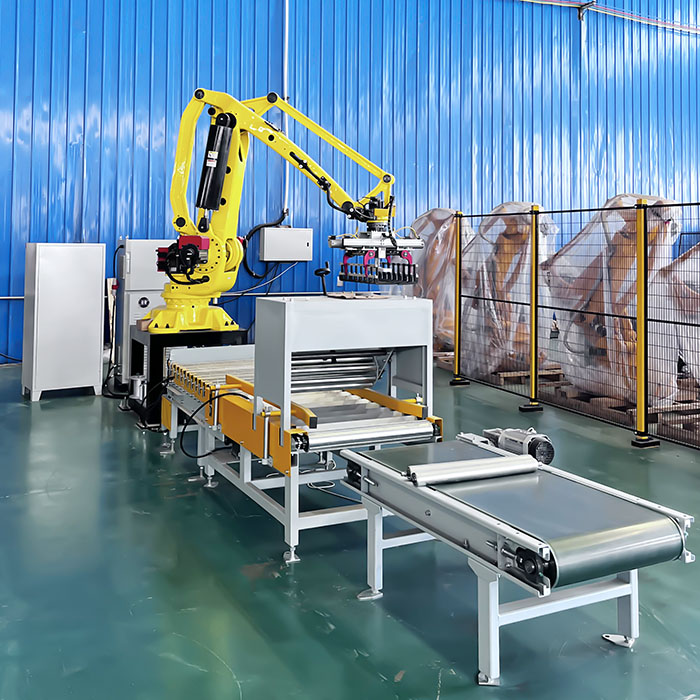
Glucose Amino Acid Palletizer
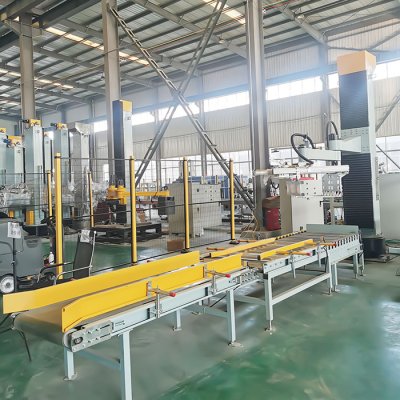
Industrial sugar palletizers are specialized equipment for automated palletizing of sugar products (such as bagged white sugar, crystal sugar, and powdered sugar). They are widely used in the food, chemical, and logistics industries. Their core advantages lie in efficiency, precision, safety, and cost control. The following is a detailed analysis:
1. Efficient Production, Significantly Boosting Capacity
High-Speed Palletizing: Robotic or gantry-type palletizers can reach speeds of 800-1500 palletizers per hour (compared to approximately 200 palletizers per hour for manual palletizing), making them suitable for large-scale industrial production.
Continuous Operation: 24/7 operation eliminates the loss of efficiency caused by manual fatigue.
Flexible Adaptability: Programmable switching between palletizing modes for different sugar bag sizes (e.g., 25kg/50kg) or sugar boxes reduces downtime during production changeovers.
2. Accurate and Stable, Minimizing Losses
High-Precision Positioning: Utilizing a servo control system and vision positioning, the system achieves an accuracy of less than ±1mm, preventing stacked sugar bags from tilting or collapsing.
Gentle Gripping: Vacuum suction cups or grippers prevent bag breakage (especially critical for fragile rock sugar and powdered sugar).
Neat Palletizing: Supports a variety of palletizing configurations (such as stacked and staggered), ensuring stable transport and storage.
3. Labor and Cost Savings
Reduced Dependence on Labor: One palletizer can replace four to six workers, reducing labor costs in the long term.
Reduced Risk of Work-Related Injuries: Avoids injuries such as back strain and injuries caused by manually handling heavy objects (such as 50kg sugar bags).
Easy Maintenance: The modular design ensures long lifespans for key components (such as sensors and motors) and low maintenance costs.
4. Intelligence and Traceability
Automated Integration: Can be integrated with filling machines, sealing machines, and conveyor belts on the production line, enabling unmanned operation of the entire process.
Data Management: Records information such as quantity, batch, and time of each pallet, facilitating quality traceability and inventory management.
Remote Monitoring: Supports Internet of Things (IoT) integration for real-time monitoring of equipment status and fault alarms.
5. Adaptable to Complex Environments
Dust- and Moisture-Proof Design: Key components are made of stainless steel or corrosion-resistant materials, given the hygroscopic and dust-prone nature of sugars.
Space Optimization: The compact structure fits within limited factory space, and three-dimensional palletizing improves warehouse utilization.
The palletizers produced by bremetz are suitable for palletizing the following industrial sugars.
1. Common types of industrial sugars
(1) Sucrose
White sugar: refined sucrose with a purity of ≥99.5%, widely used in beverages, baking, candy, etc.
Softened white sugar: finer particles, contains a small amount of invert sugar, and has a softer taste.
Brown sugar: contains a small amount of minerals and impurities, has a strong flavor, and is used for baking or seasoning.
Rock sugar: crystalline sucrose, divided into single crystal and polycrystalline, often used in beverages or stews.
(2) Starch sugar (glucose syrup)
Dextrose: produced by starch hydrolysis, used in candy, sports drinks, etc.
Fructose corn syrup (FCS): contains fructose and glucose, has high sweetness and low cost, and is commonly found in soft drinks (such as cola).
Maltose syrup: a starch enzymatic hydrolysis product with high viscosity, used in cakes, soy sauce, etc. High fructose corn syrup (HFCS): fructose content 42%-90%, widely used in the US food industry.
(3) Other functional sugars
Lactose: extracted from whey, used in infant formula and pharmaceuticals.
Sugar alcohols (sugar substitutes):
Sorbitol, xylitol: low in calories, used in sugar-free chewing gum and diabetic foods.
Maltitol: heat-resistant, used in sugar-free chocolate.
Artificial sweeteners:
Aspartame, sucralose: zero calories, used in sugar-free beverages.
2. Characteristics of industrial sugar
Large-scale production: raw materials mostly come from sugarcane, beets or corn (starch sugar).
Functionality: different sugars vary in sweetness, solubility, moisture retention, etc., and are suitable for different food needs.
3. Application scenarios
Beverages: fructose syrup (cola), white sugar (milk tea).
Baking: sugar (fluffy structure), syrup (moisturizing). Confectionery: Maltose syrup (to prevent crystallization), sugar alcohols (for sugar-free confectionery).
Prepared foods: Sugar is used for flavoring and preservation (e.g., jam).